
Beyond Passive Machines: Why Combining Active Physiotherapy with Evening RMT Speeds Recovery
If you have ever left a clinic after 20 minutes under a hot pack and a TENS machine only to have your pain return the next morning, you have experienced the passive modality trap.
Passive tools can temporarily soothe pain signals, but they cannot rebuild tendon resilience, restore joint mechanics, or correct muscle imbalances. True tissue healing requires mechanotransduction—the process where cells adapt and repair in response to mechanical loading.
To heal quickly and prevent re-injury, pairing active daytime physiotherapy with restorative evening Registered Massage Therapy (RMT) creates an optimal 24-hour recovery cycle.
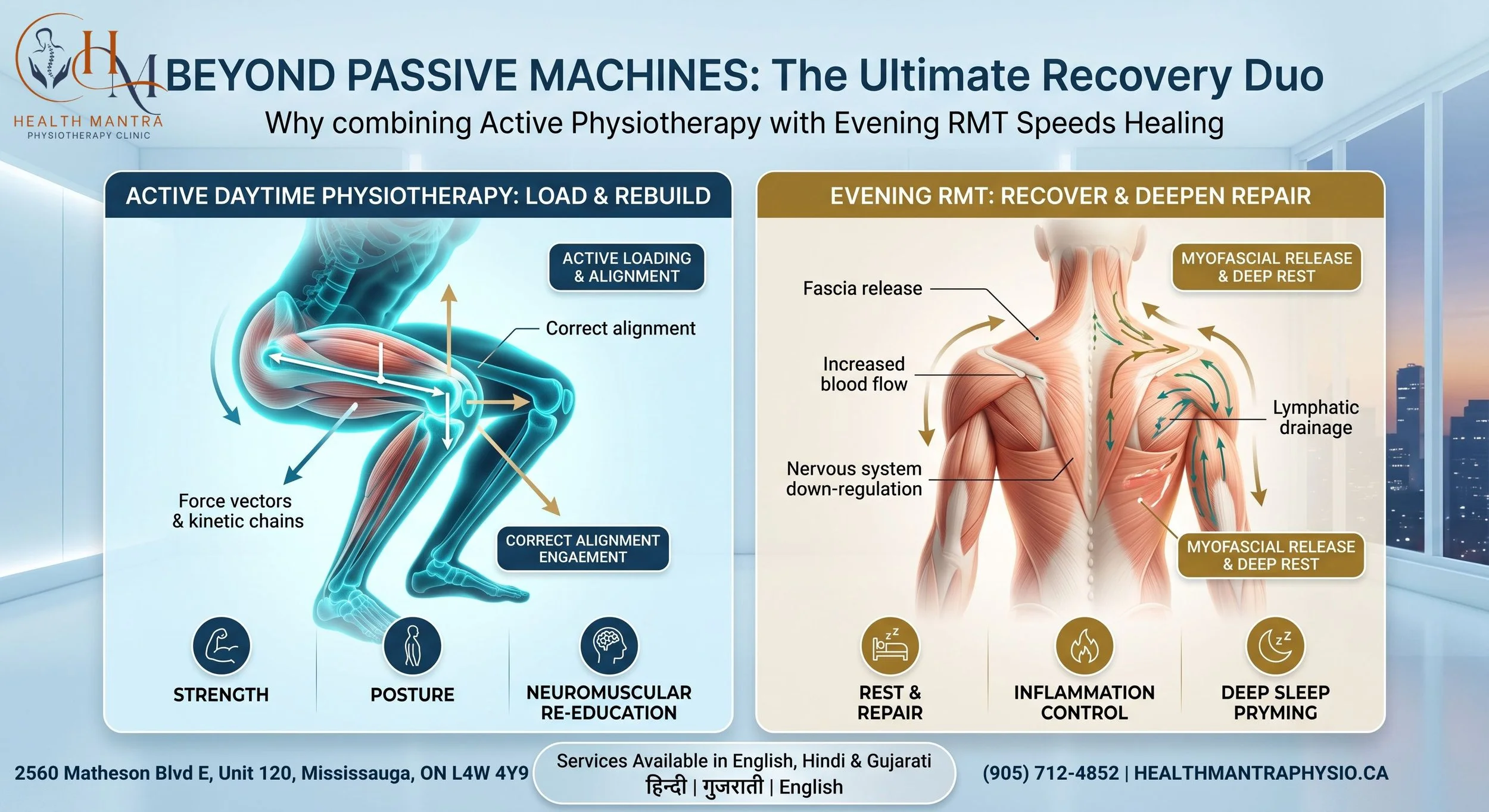
Phase 1: Active Physiotherapy Stimulates Repair
Active rehabilitation shifts focus from temporary relief to long-term physical capacity:
Collagen Realignment: Controlled resistance and eccentric exercises trigger cellular repair, turning disorganized scar tissue into strong, aligned fibers.
Neuromuscular Re-Education: Targeted movement retrains the nervous system to fire dormant stabilizers (like the deep core and glutes) instead of relying on compensatory muscle patterns.
Cartilage Nutrition: Movement acts like a sponge, driving synovial fluid in and out of joint spaces to nourish cartilage that lacks direct blood flow.
The trade-off? An effective active session fatigues tissues and elevates nervous system arousal, leaving muscles guarded and temporarily inflamed.
Phase 2: Evening RMT Accelerates the Healing Window
Scheduling an RMT appointment between 6:00 PM and 8:30 PM optimizes recovery while you sleep:
Shifts the Nervous System to "Rest and Digest": Active exercise activates sympathetic ("fight-or-flight") tone. Specialized massage techniques stimulate mechanoreceptors that engage the vagus nerve, lowering cortisol and blood pressure to allow cellular repair to begin.
Eliminates Compensatory Muscle Guarding: Targeted manual work releases surrounding muscle groups that tighten defensively after exercise, preventing stiffness from locking in overnight.
Primes Deep Slow-Wave Sleep (HGH Release): Up to 70% of human growth hormone (HGH)—essential for soft-tissue rebuilding—is released during deep Stage 3 sleep. Releasing hypertonic tension before bed prevents nighttime pain disruptions and deepens restorative sleep cycles.
The 24-Hour Recovery Blueprint
TimeModalityFocus2:00 PM – 4:30 PMActive Physiotherapy
Dynamic loading, motor control, joint mobilization.
5:00 PM – 6:00 PMNutrition & Hydration
Protein and electrolytes to supply tissue-building blocks.
6:30 PM – 8:00 PMEvening RMT
Myofascial release, lymphatic drainage, parasympathetic reset.
10:00 PM OnwardRestorative Sleep
Uninterrupted deep sleep to maximize natural hormone repair.
Common Questions
Should I get a massage before or after physio?
Always complete active loading before soft-tissue work. Pre-workout massage decreases transient muscle stiffness, reducing the joint stability required for strength drills.
Can both therapies be billed under extended health benefits?
Yes. Physiotherapy and Registered Massage Therapy fall under separate, distinct insurance buckets under most extended healthcare plans.
Rebuild Stronger
Passive machines treat pain in the moment; targeted movement paired with evening recovery rebuilds resilient tissues for the long run.
Ready to break the chronic pain cycle? Book your personalized Active Physio & Evening RMT plan today.
Consultations available in English, हिन्दी (Hindi), and ગુજરાતી (Gujarati).